Saturday, February 14, 2015

Kurdish oil: KRG. IOC, PSA, Avana Dome, Baba Dome, Kirkuk and Bai Hassan fields


After skirmishes between ISIL and KRG forces around the Kirkuk and Bai Hassan fields, the KRG took over operations at the Avana Dome, a part of the Kirkuk field, and Bai Hassan in July 2014. Shortly after, KRG restarted commercial production at those fields, which allowed the KRG to increase oil flows through its newly built pipeline that connects to Ceyhan.   

Meanwhile, Iraq's Northern Oil Company continued to produce about 120,000 bbl/d from the Kirkuk's Baba Dome, of which 30,000 bbl/d was sent to the Kirkuk refinery.16 The remainder of the oil production was reinjected into oil fields associated with natural gas to keep natural gas production flowing for power generation.

A December 2014 deal reached between Baghdad and the KRG has allowed Kirkuk crude to be transported via the KRG pipeline to Ceyhan, providing Baghdad with a commercial outlet for its northern production (see section on Issues between the Kurdistan Regional Government and Baghdad). Fighting around Kirkuk city continues to take place, making nearby fields vulnerable to supply disruptions.

International oil companies (IOCs) are very active in Iraq, including the Iraqi Kurdistan Region. IOCs operate under technical service contracts (TSCs) in Iraq, which are signed with the Ministry of Oil in Baghdad, and under production-sharing agreements (PSAs) in the Iraqi Kurdistan Region signed with the KRG. Over the years, KRG's push to sign PSAs with IOCs has escalated tensions with Baghdad, making the situation uncomfortable for some IOCs who have been pressured on different occasions to reduce their investments in Kurdistan.

Production in the northern region controlled by the KRG in the past has tended to fluctuate because of disputes with the central Iraqi government, but recently it has steadily increased. The U.S. Energy Information Administration (EIA) estimates KRG's crude oil production averaged 350,000 bbl/d during the second half of 2014. Increased pipeline capacity has allowed the KRG to increase output at its fields, while exporting it through the Turkish port of Ceyhan. 

KRG's Ministry of Natural Resources reported that oil flows through the Kurdish crude pipeline to Turkey, which started in May 2014, reached as high as 300,000 bbl/d in November 2014,9 but pipeline flows fluctuated in 2014 typically averaging below that level. The KRG also trucks between 50,000 and 100,000 bbl/d of crude and condensate to the Turkish ports of Mersin, Dortyol, and Toros, and to Iran.


November 14 2009 Tawke Talk: Galbraith replies


Peter Galbraith said his work for DNO was never secret, and his ties to the company no longer exist. His former relationship with the oil firm now is the subject of an arbitration process in London, where he is pursuing damages for breach of contract.

"I do not have any business or financial interest in DNO," Galbraith said in an interview. "I also do not have any interest in any Kurdish oil field." He said he had disclosed his ties to DNO in documents he gave the U.N. when it hired him earlier this year.


After DNO, a Norwegian company, and Genel Energy, a Turkish company, struck oil at the Tawke field in Kurdistan this year, Baghdad originally refused to export their production over its pipelines. The cash-poor government eventually relented, however, giving its approval in late May.

Exports from Tawke and from a second site in Kurdistan, at the Taq Taq field, started June 1, but Baghdad has refused to pay the companies for the oil because it continues to regard their contracts with Kurdistan as illegal.

Meanwhile, officials in Kurdistan said they could not afford to pay because revenue from the fields went directly to Baghdad. Chief Financial Officer Haakon Sandborg said the figure relates to uncertainty over the timing and final pricing of exports, as and when payments are received from Baghdad, but said "it's not an expectation that we won't get revenue" and noted it could be reversed or changed. NYTimes

Sunday, February 12, 2012

Oil and gas shale plays in Neuquen Argentina

January 2012, YPF SA (YPF, YPFD.BA), Argentina's biggest oil and gas company, said it had confirmed 927 million barrels of unconventional oil in Neuquen province. That came on the heels of last December's announcement that YPF had found an estimated 4.5 trillion cubic feet of unconventional gas at its Loma La Lata field. YPF's majority shareholder is Spain's Repsol YPF SA (REPYY, REP.MC), which has a 57.4% stake in the company. Argentina's Grupo Petersen holds a 25.4% stake while the company's free-floating shares total about 17%. The finds could position Argentina among the world's leading producers of shale oil, or unconventional oil extracted from tight sands or shale rock formations and create a large-scale boom in investment and production such as now being witnessed in North American shale plays such as Eagle Ford and Bakken,.

Wednesday, January 4, 2012

Aldous Major South - Avaldsnes- 38 days of oil


The Aldous Major South - Avaldsnes discovery on the Utsira High structure is currently estimated to contain 1.7 to 3.3 billion barrels of recoverable oil. The astonishing thing about this discovery is that it has lain undiscovered in a mature oil province for so long providing ample encouragement for explorers to go on exploring.

Tuesday, December 20, 2011

Oil Glut:light in the end of the tunnel


OPEC has decided not to cut output, despite record levels of crude in inventories and weak demand forecasts, with some cartel members believed to have ignored previous commitments to cut.
OPEC sees no need to change its guidance to oil exporters – even though oil prices are hovering around a six-month high of $63/bbl. At their meeting in Vienna members agreed stick to the current levels of output, despite oversupply, with OPEC Secretary General Abdalla Salem El-Badri, saying the organization is looking to foster economic recovery.
”The market is oversupplied, but we are seeing a light in the end of the tunnel. There is a slow recovery and we don’t want to send the wrong signal to the economy.”
With recent production cuts of 4.2 million barrels per day, OPEC members lost revenues totaling $400 million Al Badri says.
Some countries can’t withstand such losses and have exceeded their quotas – undermining OPEC’s authority,

Wednesday, December 7, 2011

North Sea Aldous Major South 1.6 bbl


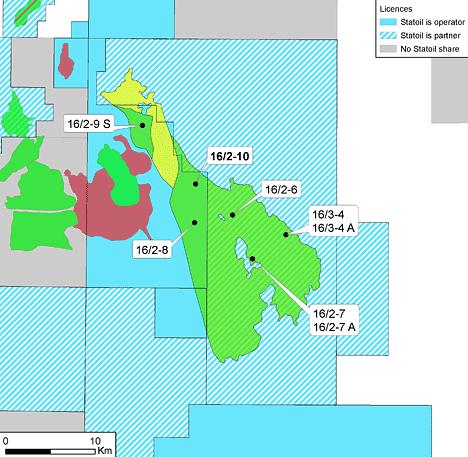
Statoil ASA , together with partners Petoro AS, Det norske oljeselskap ASA and Lundin Norway AS, has confirmed significant additional volumes in its appraisal well in the Aldous Major South discovery (PL265) in the North Sea.
The results of appraisal well 16/2-10 have increased production license PL265 estimates to between 900 million and 1.5 billion barrels of recoverable oil equivalent.
This is a doubling of the previously announced PL265 volumes of between 400 and 800 million barrels of oil equivalent.
It has previously been confirmed that there is communication between Aldous in PL265 and Avaldsnes in PL501, and that this is one large oil discovery.
“Aldous/Avaldsnes is a giant, and one of the largest finds ever on the Norwegian continental shelf. Volume estimates have now increased further because the appraisal well confirms a continuous, very good and thick reservoir in Aldous Major South,

Saturday, October 29, 2011

New world oil map


The outline of a new world oil map is emerging, and it is centered not on the Middle East but on the Western Hemisphere. The new energy axis runs from Alberta, Canada, down through North Dakota and South Texas, past a major new discovery off the coast of French Guyana to huge offshore oil deposits found near Brazil. The new hemispheric outlook is based on resources that were not seriously in play until recent years — all of them made possible by technological breakthroughs and advances. They are “oil sands” in Canada, “pre-salt” deposits in Brazil and “tight oil” in the United States.
yergin


The Zaedyus well is being drilled in the Guyane Maritime licence using the ENSCO 8503 deepwater semi submersible. The well was drilled in water depths of 2,048 metres and has been drilled to a depth of 5,711 metres. Drilling operations will now continue and the well will be deepened to over 6,000 metres to calibrate the deeper geology. The well will then likely be sidetracked to enable cores to be obtained over the reservoir sections.

Tullow (27.5%) operates the Guyane Maritime license and is partnered by Shell (45%), Total (25%) and Northpet (2.5%), a company owned 50% by Northern Petroleum and 50% by Wessex Exploration.
Tullow was citing six additional prospects off French Guiana with a similar make-up to Zaedyus suggested major potential in the coastal area extending from
Guyana through offshore Suriname and French Guiana and into
northeast Brazil's maritime area.
"It's a potential game-changer -- in the sense of the size,
that you have an area with such immense prospects," here

Saturday, January 22, 2011

Commodity prices: oil vs. wine


Emerging economies have accounted for more than 100% of the increase in global oil demand since 2000, while oil consumption in rich countries has declined. Likewise, rising incomes in emerging economies have spurred wine drinking, whereas consumption in Europe, notably France and Italy, has fallen. China (including Hong Kong) overtook Britain last year as the biggest export market for Bordeaux wines. So for both wine and oil, emerging economies now account for the bulk of incremental changes in demand and therefore have the biggest influence on prices.

Not only are emerging economies growing faster, but their growth is more energy intensive. Likewise, an increase in income seems to lead to a bigger rise in wine demand in these economies than in the rich world, and so gives a bigger boost to prices.

Monday, May 10, 2010

Falklands oil: 200 million barrels — worth £17 billion


Rockhopper Exploration, the North Falkland Basin oil and gas exploration company, has announced that the Sea Lion 14/10-B exploration well has encountered significant oil. The Sea Lion Prospect is located on Licence PL032 which is 100% owned and operated by Rockhopper.The discovery was made using the Ocean Guardian, a 14,400-tonne rig that was towed 13,000km miles from Scotland last autumn. The journey took six months. The Ocean Guardian is set to drill another four wells around the Falklands over the next few months. A Rockhopper spokesman said that the company had encountered a 53m-thick deposit of oil distributed in several layers. The largest was 25m thick.

Richard Rose, an analyst at Oriel Securities, the City firm, said that the find was “very significant” and could amount to 200 million barrels of oil — worth £17 billion at current prices. “That’s pretty chunky,” an industry source said.

Saturday, January 23, 2010

Happy Talk: 500bn barrels of crude oil


Oil companies from around the globe are lining up to participate in the Carabobo oil drilling project, which seeks to open-up untapped fields of tar-like crude in the eastern Orinoco region. This is the most touted drilling project in the region since the 1990s, when oil companies such as ConocoPhillips (COP), Total S.A. (TOT), Exxon Mobil Corp. (XOM) and Chevron Corp. (CVX) built massive extraction and upgrading projects in the area.

The initial opening of the Orinoco oil belt resulted in a major production boost in the region, but ended in legal controversy, when state-owned Petroleos de Venezuela S.A. took over control of the projects in 2007 under a new hydrocarbons law. ExxonMobil and ConocoPhillips left, starting arbitration proceedings against the country. Chevron, Total and other international companies stayed.

Companies that in recent months have shown interest in making a bid for the Carabobo project include China National Petroleum Corp., or CNPC, Total, Spain's Repsol YPF SA (REP, REP.MC), Royal Dutch Shell PLC (RDSA, RDSA.LN) and India's Oil & Natural Gas Corp., or ONGC (500312.BY). Scientists working for the US Geological Survey say Venezuela's Orinoco belt region holds twice as much petroleum as previously thought.

The geologists estimate the area could yield more than 500bn barrels of crude oil. Saudi Arabia has proven reserves of 260bn barrels.

Wednesday, January 20, 2010

Incentives for states to raise production


The 2010 mean demand estimate of 86.3 mb/d compared to December global supply of 86.2 mb/d, on an unexpected rise of 270 kb/d, suggests that supply is gaining while demand growth, rooted in non-OECD developing Asian countries, is less than stable. Also important are upside supply surprises from the OPEC 12, which prove that there are incentives for the cartel member states to raise production levels at these prices. here

Thursday, November 12, 2009

Oil company drafting Iraqi Constitution speechless


“The idea that an oil company was participating in the drafting of the Iraqi Constitution leaves me speechless,” said Feisal Amin al-Istrabadi, a principal drafter of the law that governed Iraq after the United States ceded control to an Iraqi government on June 28, 2004.

In effect, he said, the company “has a representative in the room, drafting.”

DNO’s chief executive, Helge Eide, confirmed that Peter Galbraith helped negotiate the Tawke deal and advised the company during 2005. But Mr. Eide said that Mr. Galbraith acted solely as a political adviser and that the company never discussed the Constitution negotiations with him. “We certainly never did give any input, language or suggestions on the Constitution,” Mr. Eide said.

Mr. Galbraith did work as a mediator between DNO and the Kurdish government until the oil contract was signed in the spring of 2004, and maintained an “ongoing business relationship” with the company throughout the constitutional negotiations in 2005 and later.

Galbraith recently was in the news after being fired from his post at the U.N. mission in Afghanistan because, Galbraith says, he had strongly warned about the possibility of fraud and corruption before Afghanistan's ill-fated presidential election in August.

The reply from Hawrami, also dated Oct. 5, called the issues arising from the regulatory probe "unfortunate internal disagreements" with the Oslo Stock Exchange, which "were exploited by the media beyond DNO's control."


That scandal is taking place in Norway, where Galbraith, the son of famed Harvard economist John Kenneth Galbraith, lives in Bergen with his Norwegian wife.

Norway's largest financial newspaper, the "Dagens Naeringsliv," reported last week that Galbraith acquired a 5 percent share in an oil field in the Iraqi Kurdish region at a time when he was a leading voice in the U.S. debate over the structure of post-Saddam Iraq.

At the time, the former diplomat urged in meetings with U.S. officials and in articles in the "New York Review of Books" that the Kurds should be given maximum autonomy.

And he helped draft Iraq’s 2005 constitution by advising Kurdish leaders on legal language they should seek to insert into it -- including keeping future oil development in their region under their own control.

In the lead-up to the Iraq war, Galbraith worked as an adviser to then-U.S. Deputy Defense Secretary Paul Wolfowitz. Galbraith then left government service and in late 2003 and early 2004 worked as a paid consultant to Kurdish politicians. Later, in 2005, he advised them again on an unpaid basis.

Oslo-based DNO was the first independent Western oil company to secure an oil deal in post-Saddam Iraq, signing a production sharing contract with the Kurds in June 2004 to develop the Tawke field. DNO also has stakes in two other oil fields in the region, which are both still at the exploration level.

Wednesday, July 29, 2009

long-dated U.S. crude oil futures


Declining demand in a global recession has produced a glut of crude at the massive Cushing oil storage terminal. Storage capacity at Cushing, about 70 miles northeast of Oklahoma City, is expected to exceed 55 million barrels by the end of the year. The premium for long-dated U.S. crude oil futures has grown dramatically since mid-July 2009, which should spur traders to hoard more crude on land and at sea to turn a profit.

Friday, June 19, 2009

Norway supply renewed in Norwegian Sea


A/S Norske Shell, operator of production licence 326, has hit gas with wildcat well 6603/12-1. The discovery is located 150 kilometers (93 miles) northwest of the 6506/6-1 Victoria gas discovery in the northern Norwegian Sea.
Well 6603/12-1 is being drilled by Ocean Rig semisub "Leiv Eiriksson". The prospect is located in license PL 392. “The well hit a 16-metre gas column in the Upper Cretaceous, in a reservoir of varying quality,” the Norwegian Petroleum Directorate said.


Leiv Eiriksson Drilling Rig
- Semisub - 5

The offshore drilling rig Leiv Eiriksson is a Semisub type rig. It is currently owned by Ocean Rig Asa.
Leiv Eiriksson Semisub Drilling Rig Specification:
Design: Trosvik Bingo 9000
Built: Friede & Goldman at the Friede & Goldman, Pascagoula, Mississippi shipyard
Age: 2001
Drilling Rig Type: Semisub
Additional Type Spec: 5
Water Depth Rating: 8,200 ft
Drilling Depth: 30,000 ft
Classification: DNV

Monday, March 30, 2009

crude storage facilities brimming


The U.S. government last week said crude storage facilities were brimming with more oil than they've had in 16 years. Combined with the strategic petroleum reserve, the nation now has 1.05 billion barrels of oil in storage -- enough to fuel roughly 44 million cars for a year.

Saturday, March 14, 2009

Western Hemisphere's largest find in three decades.


Exxon Mobil Corp.’s oil discovery off the coast of Brazil may hold enough crude to rival the nearby Tupi prospect as the Western Hemisphere’s largest find in three decades.

Exxon Mobil’s Azulao-1 well in an offshore region designated BM-S-22 tapped a reservoir that could contain 8 billion barrels of recoverable oil, A floating drilling rig began boring a second well, called Guarani, into the reservoir in BM-S-22 earlier this week.

“We have no idea how big it is,” McGinn said “We’re nowhere near that yet.

Petrobras triggered a flood of interest in Brazil’s offshore crude deposits with the November 2007 announcement that Tupi may hold the equivalent of 8 billion barrels of recoverable oil. That would make it the largest find in the Americas since Mexico’s Cantarell field was discovered in 1976.

Domestic oil production is expected to increase this year over last, for the first time since 1991. That swing is attributable in part to increased production in the Gulf of Mexico from two giant new platforms that were years in the making. Domestic natural gas output rose by almost 8 percent last year from 2007, the biggest annual jump in more than a generation.

Tuesday, February 17, 2009

Crude should trade at $21.


In the late 1990s, oil companies traded on valuations that assumed a long-term oil price around $15 a barrel. The oil price should rise at the rate of global inflation, all other things being equal. Assume it was $15 in 1995. Then today it should be $21. Crude oil traded near $37 a barrel in New York on Tuesday, February 17, 2009.

Tuesday, February 10, 2009

Hayward says increase refinery capacity now


The challenge for all of us is to not allow this cyclical fall to pitch us into a structural loss in capacity," BP Plc Chief Executive Tony Hayward said. BP operates five U.S. refineries that in aggregate can process 1.54 million barrels of crude a day,

Thursday, December 11, 2008

World's need for oil is ebbing quickly


The steep continued drop in Chinese oil use is one of the main reasons analysts are now predicting that world-wide crude consumption will decline both this year and next. The world's need for oil is ebbing so quickly that big producers from the Organization of Petroleum Exporting Countries such as Saudi Arabia and Iran may not be able to trim production fast enough, leading to an oversupply that some analysts now say could keep prices below $50 a barrel for all of next year.The US Energy Information Administration said in December 2008 that it expected global oil demand to slump by 50,000 barrels a day this year and 450,000 barrels a day next year, representing the first year-to-year drop in world oil demand since 1983

Saturday, November 15, 2008

New Brazilian oil


The Tupi field holds an estimated 5 to 8 billion barrels of oil. The nearby Iara field holds up to 4 billion barrels. But analysts estimate that the region could contain up to 80 billion barrels, about the same as Venezuela.

Monday, October 20, 2008

There is plenty of oil


At the end of 2007 total remaining proved reserves stood at around 2.3 trillion barrels of oil equivalent. At today's consumption rates, we believe we have around 40 years of proven oil reserves, 60 years of natural gas, and 130 years of coal.
The task facing the world is to bring this oil and gas to market. These resources are found in increasingly challenging environments - in the deserts of the Middle East and North Africa; in the deepest waters of the Gulf of Mexico, West Africa and Brazil; and in the Alaskan and Russian Arctic.

Turning these resources into reserves and then production is going to require ingenuity, innovation and technology. Indeed I believe that capability is now the industry's greatest challenge. Many experienced people are retiring; there are fewer graduates with the right qualifications, and not enough of them are joining the industry. This is why we are increasing the scale of our graduate recruiting, and upskilling the capability of our current employees through the establishment of BP academies for operations and projects in partnership with leading universities. read

The world has 1.3 trillion barrels of proven reserves, enough for 40 years at current rates of consumption. “Peak oil is about geology,” notes Marianne Kah, chief economist at ConocoPhillips. “I don’t think we are running out of oil. We are running out of access to oil.”

Kah is right: there is plenty of oil. But it cannot be withdrawn at will like money from an A.T.M.; wells yield only so much liquid per day. And since the flow from aging wells declines by about 5 percent a year, producers that stand pat will shrink. To stay even requires investment — and usually, the incentive of a high price. It also takes time. read